|
|
|---|
Monday, June 28, 2010
Gordon Murray's (Controversial) T.25
Mandatory Breathalyzer Interlock?
Preview: 2011 Aston Martin DB9

Aston Martin is set to start deliveries of its new DB9 model next month after the highly desirable car received its most significant upgrade since its world debut in 2003.
The exterior styling changes of the 2011 Aston Martin DB9
include a new front bumper, bright finish radiator grille and a reshaped lower intake. The can also comes with new headlight bezels and clear rear light lenses, new sills, silver brake calipers, 20-spoke alloy wheels.
There’s a new front bumper and the grill gets a bit of sparkle. The lower intake gets a re-shape and a bit of bright hexagonal mesh and there’s new headlight bexels. The sills get a re-shape, there’s new alloys, silver brake callipers and clear light lenses. And that’s it. As we said – new makeup, not a stretched and manic looking Florida facelift.
The Aston Martin DB9 is available as either Coupe or Volante (convertible) with rear mid-mounted six-speed manual gearbox as standard or optional ‘Touchtronic 2’ six-speed automatic transmission. Production of the revised DB9 is already underway, with deliveries commencing in July. Prices start from £122,445 for the DB9 Coupe and £131,445 for the DB9 Volante.
Press Release
In the most significant programme of upgrades since its world debut in 2003, Aston Martin DB9 range has received a complete package of styling, engineering and equipment enhancements.
As the most successful Aston Martin of all-time (an honour it shares with the V8 Vantage) the DB9 has established itself as the definitive grand tourer, thanks to an enduring combination of understated elegance, sporting character and genuine luxury.
For Dr Ulrich Bez, Aston Martin's Chief Executive, the Aston Martin DB9 remains a very special car: "The DB9 is the quintessential sporting grand tourer and offers an unrivalled combination of driver involvement, character, luxury and refinement. This car combines our unique Aston Martin character with an uncompromised design philosophy, craftsmanship and trademark Aston Martin performance ability."
This new package of improvements compliments these core qualities perfectly. Subtle styling changes freshen the Aston Martin DB9's appearance, with a new front bumper, bright finish radiator grille and a re-shaped lower intake featuring bright hexagonal mesh. New headlight bezels, re-styled sills, silver brake calipers, 20-spoke diamond turned alloy wheels and clear rear light lenses complete the external revisions.
Under the skin the Aston Martin DB9's passive damping system has been replaced by a new Adaptive Damping System (ADS), which offers enhanced ride comfort together with sharper handling when switched to Sport mode. The ADS system is offered as standard equipment across the Aston Martin DB9 range, encompassing both Coupe and Volante (convertible). A new tyre pressure monitoring system, a revised Bluetooth microphone system and the addition of a new Double Apex alloy finish trim and Bang & Olufsen hi-fi options broaden the Aston Martin DB9's specification.
Aston Martin's Product Development Director, Ian Minards, explains that it is all part of an ongoing commitment to continual improvement: "The Aston Martin DB9 was the first car built at Gaydon adopting the VH architecture. It has evolved every year since, with significant changes including a power upgrade and successive reductions in CO2 emissions. The latest package of improvements goes further than ever, highlighting the Aston Martin DB9's qualities as a true sporting GT and underlining its role as the backbone car of our range."
The Aston Martin DB9 is available as either Coupe or Volante (convertible) with rear mid-mounted six-speed manual gearbox as standard or optional 'Touchtronic 2' six-speed automatic transmission. Production of the revised Aston Martin DB9 is already underway, with deliveries commencing in July. Prices start from £122,445 for the Aston Martin DB9 Coupe and £131,445 for the Aston Martin DB9 Volante.
Background
The introduction of the DB9 marked the beginning of Aston Martin's 21st Century renaissance. The first new model to be built at Aston Martin's headquarters in Gaydon, Warwickshire, and the first to be built around Aston Martin's rigid, lightweight, bonded aluminium VH architecture; the Aston Martin DB9 was an immediate and unparalleled success, setting a new tone for Aston Martins of the future.
Since its launch in 2003 some 12,500 DB9s have been produced and delivered to customers in 34 countries. This establishes it as the most successful Aston Martin model of all-time (jointly with the V8 Vantage), surpassing total sales of the DB7. Current Aston Martin DB9 production volume is around 1,500 cars per year.
Engineering
Since the DB9's introduction Aston Martin has demonstrated the versatility of the VH architecture by developing the Vantage, DBS and Rapide model ranges. In the process Aston Martin's engineers have gained an increasingly detailed understanding of the VH platform, which in turn has led to the constant improvement and evolution of existing established models.
In this latest package of improvements for Aston Martin DB9, hardware changes focus on the chassis, featuring a standard Adaptive Damping System (ADS) which offers a system constantly evaluating the optimum damper condition, similar to that seen on the DBS and Rapide models. Controlled by a button on the centre console, the two-stage adaptive dampers can be switched between their default mode, which is optimised for ride comfort, and a firmer sport mode, which delivers tighter body control and a more responsive feel. Such is the success of the Aston Martin DB9's new damping system that the DB9 Sport Pack upgrade has now been discontinued. However a Sport design alloy wheel is available as an option.
Performance comes courtesy of Aston Martin's celebrated 6.0-litre V12 engine, which develops an unchanged 470bhp and 442lb ft of torque. Mated to a choice of six-speed 'Touchtronic' paddle-shift automatic or six-speed H-pattern manual transmissions, the Aston Martin DB9 offers an intoxicating blend of effortless pace and sporting character. A top speed of 190mph and the ability to hit 60mph in just 4.6sec seal its credentials as the definitive 2+2 Grand Tourer.
Design
Improving upon what many consider to be one of the most beautiful cars in the world is a delicate exercise. According to Aston Martin's Director of Design, Marek Reichman, subtlety and fine attention to detail is the key: "The beauty of an Aston Martin comes from harmonious proportions, a ground-hugging stance, taut surfacing and a complete and thorough attention to detail. The Aston Martin DB9 epitomises these qualities; it is beautiful but subtle - not attention seeking."
At the front a new bumper is the main change, with a re-shaped lower intake featuring hexagonal mesh to compliment the new bright finish radiator grille. New headlamp bezels complete the fresh nose treatment. In profile the Aston Martin DB9's sill has also been changed, with a more prominent 'hockey stick' curve ahead of the rear wheels. Marek Reichman explains: "The DB9 remains one of the world's most beautiful sports cars and is instantly recognisable as an Aston Martin; the changes we have introduced here modernise the Aston Martin DB9 to keep it at the forefront of automotive design."
Other changes include silver brake calipers, 20-spoke diamond turned alloy wheels as standard, together with new design option wheels and a bright finish grille. Clear rear light lenses are also standard. Inside Double Apex alloy finish is now added to the list of options, along with the exceptional BeoSound audio system from Bang & Olufsen.
Motorsport
Mirroring the Aston Martin DB9's road-going success, Aston Martin Racing's DBR9 and DBRS9 endurance racers have proved hugely successful on racetracks around the world. With a total of some 20 DBR9 and 30 DBRS9s built and delivered to customer teams around the world, Aston Martins have consistently scored victories in a host of national and international championships.
Since winning on its race debut, at Sebring in 2005, the DBR9 has been established as a constant and hugely competitive car in the GT1 category, scoring back-to-back class victories at the greatest 24-hour race of them all - Le Mans - in 2007 and 2008.
Sunday, June 27, 2010
Lamborghini Gallardo milestone reached
The car, in Midas yellow LP 560-4, will be delivered to its Chinese owner.
Initially launched in 2003, the Gallardo rapidly became one of the most popular supercars in the world. Over the years, Lamborghini expanded the model range by introducing variants like the LP 560-4 Spyder, the LP 550-2 Valentino Balboni, and the LP 570-4 Superleggera.
According to Stephan Winkelmann, President and CEO of Automobili Lamborghini, "The Lamborghini brand is extreme, uncompromising and Italian, and the Lamborghini Gallardo has played an exemplary role in defining and delivering our brand reputation into our worldwide markets. Today Lamborghini is represented in 45 countries by over 120 dealers, with the strength and presence of the Gallardo product playing a significant role in the growth and recognition of our brand."
Saturday, June 26, 2010
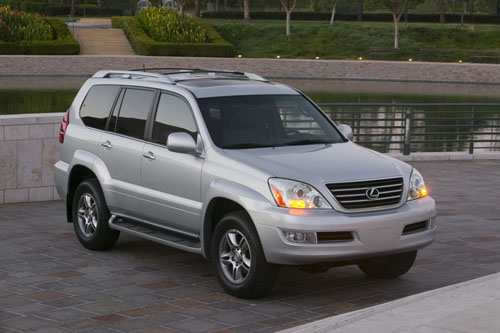
2009 Lexus GX470 Specifications And wallpapers
The GX 470 midsize SUV continues the Lexus tradition of offering high levels of luxury in a vehicle that is both quiet and comfortable. With three rows of seating, a smooth V8 engine and refined interior, the GX is a top-tier luxury SUV in every sense of the term. In addition, this particular Lexus has the ability to venture further off-road than most of its owners will have the desire, or courage, to take it.
However, the Lexus GX 470 has been on the market for more than a few years now, and in that time the crossover SUV market has become much more popular. Although its rugged truck-based underpinnings provide advantages in terms of towing or going off-road, the resulting higher weight, lower fuel economy and decreased space efficiency means this Lexus may not be the best choice for the type of on-road driving that most luxury SUV owners spend the majority of their time doing. In addition, the GX 470 falls a bit short in terms of the latest luxury features when compared to newer competition.
Current Lexus GX 470
The current Lexus GX 470 is a traditional body-on-frame SUV. Mechanically, it's related to the Toyota 4Runner. There are two trim levels: base and Sport. Both are powered by a 4.7-liter V8 that produces 263 horsepower and 323 pound-feet of torque. A five-speed automatic is standard and it sends engine power to a full-time four-wheel-drive system with low-range gearing.
The Lexus GX 470 is also equipped with Downhill Assist Control (DAC), Hill-start Assist Control (HAC) and Rear Adjustable Height Control (AHC). During a low-speed descent, DAC can help keep speed in check without constant input from the driver. HAC helps keep the vehicle stationary while starting on a steep incline or slippery surface. AHC offers the ability to increase or decrease the rear height of the GX 470 over a nearly 3-inch range, enhancing either off-road ability or cargo loading, depending on setting.
This Lexus SUV is also available with a Kinetic Dynamic Suspension System (KDSS). When equipped, KDSS automatically adjusts the front and rear stabilizer bars to enhance handling under a variety of conditions, both on- and off-road.
Luxury is what Lexus is known for, and the interior of the GX 470 offers fine leather on the seats and lustrous wood on the dash and steering wheel. However, some luxury features found on some competitors' vehicles are not available on the GX 470. These include automatic tri-zone climate control, an extra-large sunroof, power liftgate, blind spot sensors, adaptive headlights and ventilated front seats. Other shortcomings include third-row seats that don't fold flat into the floor and a rear cargo door that swings to the curb instead of upwards.
Past Lexus GX 470 Models
The Lexus GX 470 was introduced for the 2003 model year. The following year saw safety upgrades that included a roll-sensing feature for the side curtain airbags, a tire-pressure monitoring system and an optional rear back-up camera system (for those vehicles with the navigation system installed). The optional KDSS was available as a late-year addition.
A Sport trim joined the lineup for 2005. Other GX option changes included an upgraded navigation system with better graphics and additional functions, Bluetooth compatibility and voice commands for the climate control, audio and navigation systems. Horsepower increased to 270 (up from 235). For 2006, the GX 470 offered a new optional second-generation Lexus Link system and featured minor interior trim changes. In addition, new SAE engine-testing procedures resulted in a slight drop in the amount of stated power for the V8, from 270 to 263.
Lexus upgraded the navigation system for 2007 with voice activation and an enhanced display. Other changes include the addition of an input jack (for digital music players) and DVD-Audio capability for the optional Mark Levinson premium audio system (which also plays conventional and MP3/WMA-formatted CDs). The Levinson system also allowed a DVD movie to be played on the navigation system's screen. That year also saw the display for the available rear-seat entertainment grow to a 9-inch wide-format screen.
THE NEW GEM ‘’NISSAN SKYLINE SPEC-V’’

So do not break the design of new car companies. Today we are witnessing the same thing a number of super cars. In addition, the company does not get tired of working so hard for designers too (it would be necessary to find the secret of this energy too!) One company that is designing the cars are so simple, and recently has been a super car,


SpecV can be powered from a 3.8-liter V6 engine. New gear to increase the controller allows the car is increased impetus to provide more torque. Titanium exhaust with the assembly of the suspension made the car less than half as much as important as the upper half. SpecV has decided to launch in Japan only for now. So you should better put your chop sticks, not to buy this car is a big mistake.